Guest Contributor, Yael
Such clarity and TRUTH. A MUST Read....yes, long, but worthwhile.
From Sinai to the Jordan
Modern
people love mercy. Until blood shows up. Then suddenly everyone gets
uncomfortable and starts trying to turn Leviticus into “symbolic
spiritual metaphors” because the modern religious imagination prefers
therapy language to sacrifice language.
But Scripture refuses to let humanity escape one terrifying truth… Sin costs blood.
Not
because YHWH is cruel, but because the natural consequences of
rebellion are death. And nowhere is that reality more intense than the Day of Atonement.
Leviticus
16 is not random ritual. It is one of the holiest, most frightening
moments in all of Torah. One day. One man. One entrance beyond the veil.
One nation waiting outside while the High Priest approaches the divine
presence carrying blood.
The
entire chapter feels dangerous. Because it is. YHWH literally begins
the instructions by referencing Nadab and Abihu - the sons of Aaron who
died offering unauthorized fire before Him (Leviticus 16:1). That is the
warning hanging over the chapter. You do not approach holy presence
casually and survive. Modern culture treats YHWH like an emotionally
supportive life coach. Leviticus presents Him as blazing holiness
dwelling behind a veil. That changes the atmosphere immediately.
Aaron
cannot simply stroll into the Holy of Holies whenever he feels
spiritually inspired. YHWH explicitly says: “Tell Aaron your brother not
to come at any time into the Holy Place inside the veil… so that he may
not die” (Leviticus 16:2). Not “IF he may not die.” THAT he may not
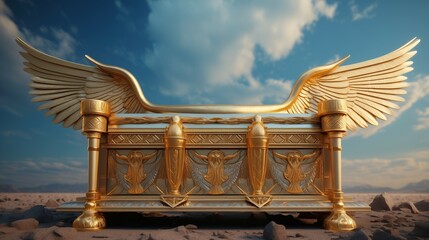
die. The danger is assumed. And inside the Holy of Holies sits the ark.
The covenant. The cherubim. The glory. And over the ark is the mercy
seat.
This is one of the most misunderstood images in Scripture.
People
hear “mercy seat” and imagine something soft and sentimental, like a
plush couch at Grandma’s house with soft throw pillows and weighted
blankets. No. The mercy seat sits above the Law. Above the testimony.
Above
the covenant humanity keeps violating. And blood is sprinkled there.
Why? Because mercy does not ignore justice. It covers it. That
distinction matters violently.
Modern
spirituality often imagines mercy as YHWH lowering His standards and
pretending sin is not serious. But, biblical mercy is far more costly.
Blood stands between holy judgment and guilty people. That is the mercy
seat. And the
imagery is terrifyingly beautiful. Inside the ark sit covenant tablets
as testimony against rebellion and witness of divine holiness. Above it
is blood, mercy and covering.
Mercy
does not abolish holiness. Mercy makes survival possible in the
presence of holiness. The tablets inside the Ark are often called "the
Law," but Torah actually calls them the Testimony. Think about that. The
witness. The evidence. The covenant document itself.
Those
stone tablets testified to what YHWH had spoken and what Israel had
agreed to. In a sense, they stood as witnesses for the covenant and
witnesses against covenant breaking. The testimony remained. The
evidence remained. The standard remained. And directly above that
testimony sat the mercy seat. Not removing the witness. Not destroying
the evidence. Covering it. That is an astonishing picture.
Modern
religion often imagines mercy as YHWH throwing away the covenant and
pretending the violation never happened. But the mercy seat tells a
different story. The covenant still exists. The testimony still exists.
The witness still exists. The standard has not changed. Mercy is not
found by eliminating the testimony. Mercy is found above it. Covered by
blood.
The Hebrew word translated "mercy seat" is kapporet. It comes from the same root as Yom Kippur. Atonement. Covering.
Suddenly the imagery becomes overwhelming. The testimony below. The
covering above. Blood upon the covering. And the presence of YHWH
appearing above the blood.
The
entire Gospel of the Kingdom is sitting there in gold and acacia wood.
Humanity stands condemned by the testimony beneath. Yet YHWH chooses to
meet His people above the covering. Above the blood. Above the place
where mercy and justice meet. And notice what is not above the Ark.
There is no throne of denial. No throne of lowered standards. No throne
of "sin isn't really that serious." There is a mercy seat. Which means the testimony remains true. The violation remains real.
Holiness remains unchanged.
Yet
mercy still triumphs. Not because justice disappeared. Because justice
was satisfied. That will preach hard! Especially because modern
Christianity often accidentally presents grace as divine indifference.
As though YHWH shrugged at sin and decided standards were too stressful.
No. Grace is expensive! Leviticus screams that.
And then comes the scapegoat.
One
goat slain. One goat sent into the wilderness bearing the sins of the
people (Leviticus 16:7-10, 20-22). Two goats. One atonement. The imagery
here is enormous. Blood deals with guilt. The wilderness goat carries
away uncleanness and exile imagery. Sin produces separation. Always. And
honestly, the wilderness imagery matters deeply because Israel itself
keeps flirting with becoming spiritually wilderness-like through
rebellion.
The
scapegoat carries impurity away from the camp because YHWH is teaching
Israel something terrifying… sin contaminates sacred space. Modern
people treat sin like a private lifestyle preference. Scripture treats
sin like corruption spreading through holy space. That is why cleansing
exists. That is why atonement exists. That is why blood exists.
And
then the High Priest enters beyond the veil. Alone. Not casually. Not
confidently in himself. Not swaggering into the Presence like a
spiritual influencer with a stage microphone and skinny jeans. With
fear. With blood. With incense clouding the mercy seat “so that he does
not die” (Leviticus 16:13). The incense creates a covering cloud over
the presence itself, like the cloud over Sinai.
Again… Boundaries. Protection. Mercy.
Everything in the Tabernacle teaches the same lesson, that nearness to YHWH is astonishing… and dangerous. That
tension runs through the whole Bible. People today often talk about
“running into YHWH’s presence” with almost no category for holiness.
Meanwhile in Scripture priests tremble, mountains shake, glory fills
rooms, people fall on their faces, blood is required and access is
restricted. Yet, the fear (not the afraid kind of fear - reverence, awe, and respect) of YHWH has nearly vanished from modern Churchianity!
But
you cannot read Leviticus honestly and keep treating holiness casually.
And, that is exactly why Messiah changes everything so dramatically.
Because Hebrews grabs all this Tabernacle imagery and detonates it
Christologically. Yeshua is the High Priest, the sacrifice, the
mediator, the blood, the atonement and the one entering beyond the veil.
Hebrews 9 says Messiah entered “once for all into the holy places… by
means of His own blood” (Hebrews 9:12).
Do
we understand how staggering that is? The earthly priest entered
repeatedly. Messiah enters once. Animal blood covered temporarily.
Messiah’s blood accomplishes fully. The earthly sanctuary was a shadow.
Messiah enters the greater heavenly reality itself. And then the veil
tears. Oh, the beautiful veil! The massive woven barrier embroidered
with cherubim - guardians of sacred space - tears from top to bottom at
Messiah’s death (Matthew 27:51). Not from bottom upward. From top
downward. YHWH tears it. The barrier opens. Access changes. The garden
begins reopening.
And suddenly Leviticus 16 starts blazing with prophetic meaning.
The
mercy seat was always pointing forward. The blood was always pointing
forward. The priesthood was always pointing forward. The Day of
Atonement was always pointing forward. Toward the moment when the true
High Priest would enter through His own sacrifice and open the way
permanently. And yet holiness does not disappear. That is crucial!
Modern Chrurtianity sometimes speaks as though grace abolished holiness
entirely and replaced it with divine chill vibes.
No. Hebrews still says: “Our God is a consuming fire” (Hebrews 12:29). Same God. Same holiness. Same glory. What
changes is access through Messiah. Not the nature of YHWH. And
honestly, this is where many modern distortions collapse. So many people
want intimacy without reverence. Access without repentance. Mercy
without transformation.
But
the mercy seat itself teaches otherwise. Blood stands between humanity
and judgment. That means sin is serious. Very serious. And yet mercy
triumphs there. Not by abolishing justice. By satisfying it. And again,
one of the most beautiful details is this: The mercy seat sits ABOVE the
Law. Not instead of it. Above it. Mercy covers what the Law condemns.
That
line alone could explode modern theological arguments into orbit,
because Scripture never presents mercy and holiness as enemies. They
meet together. At the mercy seat. In blood. And this entire terrifying,
beautiful system sits right in the middle of the wilderness while Israel
repeatedly rebels. Complaining. Idolatry. Lust. Fear. Unbelief. The
camp keeps failing. But the blood keeps speaking.
And
all of it points toward the greater reality still coming: the true
Priest the true sacrifice the true entrance beyond the veil the true
restoration of communion because the ultimate goal was never merely
surviving judgment. It was restored dwelling. A holy God living among a
redeemed people without consuming them. That is what the mercy seat was
always whispering through bloodstained gold in the middle of the
wilderness. The Law remains. The blood is applied. The presence
descended. Maybe the battle between law and grace was never in the Ark
at all. Maybe they were meeting together above it the whole time. The
witness is still there. The testimony is still there. The standard is
still there. And the blood is still speaking. Because of the Blood of
the Lamb we are now able to approach God through His Son, our High
Priest, Our Savior. Not as strangers, but as children of the Most High.
The
question is: When the testimony bears witness against you will you be
found keeping His Commandments and seeking first the Kingdom of God?
You are cordially invited to join Renew Your Strength Bible Study Group
The purpose of this post is to get people to think about what they believe and why they believe it, not debate who's right or wrong.
To
learn the revealed truth of God we must know and understand the true
meaning of the words God inspired to be written. Use Strong's
Concordance to check the original word before it was translated. Do your own research, make up your own mind, rely on the Holy Spirit to guide you. God always gives us a choice. We can choose to believe the Truth of the Bible, or we can choose the lies of the Adversary.
