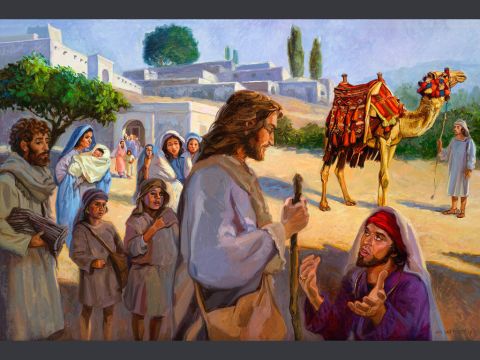
When
Jesus started His public ministry, He did not call the learned Rabbis.
He called fishermen, tax collectors, shepherds, farmers, shopkeepers, inn keepers, seamstresses, homemakers...
the common man and woman.
Jesus did not incorporate His Church and hire men to preach. As it is written: The general assembly of God and church of the first-born are registered in heaven (not a corporation registered on earth) ~ Hebrews 12:23. Jesus did not build a "church" building, have altar calls, teach the "sinner's prayer," have a "praise and worship team," teach earthly riches, take communion every Sunday, or observe pagan holidays. God is not confined to Temples or Church buildings. He chose the human heart as His dwelling place. As it is written: "Do you not know that you are God's temple and that God's Spirit dwells in you?" ~ 1 Corinthians 3:16
Five Things Jesus Never Said
1. Ignore the Sabbath Day, I changed it to the Sunday.
2. I came to destroy the Law and the Prophets.
3. I promise you will go to heaven if you believe in me.
4. Don't worry about enduring tribulation, I will rapture you.
5. To honor me, take communion every Sunday, hunt Easter eggs and celebrate my birthday.
Five Things Jesus Did Say
1. The Son of Man is Lord of the Sabbath. ~ Matthew 12:8
2. Do not think that I came to destroy the Law or the Prophets. ~ Matthew 5:17-18
3. I came to announce the Kingdom of God on earth. ~ Luke 4:43
4. He that endures to the end will be saved.
5. Jesus told Paul to remind His followers to observe the Passover. ~ 1 Corinthians 5:7-8
The early Church was taught how to qualify for citizenship in The Kingdom of God, not how to go to heaven or avoid hell.
During the first three centuries of Christianity, the Church met on the Sabbath in small groups in a home, sang hymns (especially the
Psalms), read from the Scriptures, and kept the feasts of the Lord.
Sometimes someone may have a word to share, or there was group
discussions about the letters the Churches would receive from one of the
Apostles. In the early Church, breaking bread referred to the everyday act of sharing meals together in one another's homes. The
Apostles appointed able men to care for the flock. That was it... no
paid clergy, no earthly headquarters, just Brethren seeking the Kingdom
of God. ~ Matthew 18:20
Pastors
and Elders were chosen from the local congregation. These men did not
quit their job to get paid for their service to the Church. Ministry is a service not a payday. Most preachers today attend a Bible college of their chosen denomination. To get, and keep, a full time preaching job they must stick to the established doctrines of that Church. Once a Church organization publishes a "Statement of Faith," they stubbornly refused to make any corrections.
As
false teachers begin to creep into the congregations, they led people
away from the doctrines of the Apostles. Wolves in Sheep's clothing
formed their own Churches with their own doctrines. The main
organization that emerged was the Roman Catholic Church. Then in the
16th century came the protestant reformation that spawned thousands of
church organizations. Organized religion hijacked Christianity and
turned it into a hodge-podge of confusing doctrines and practices.These false teachers turned Shepherds into hirelings - someone who works solely for monetary compensation rather than out of loyalty, passion, or moral conviction.
Jesus never promised His followers a "mansion in heaven", He promised a Kingdom on earth. One
reason people have a hard time believing the Gospel (Good News) is
because it seems too good to be true. A man named Jesus/Yahshua claims to
be the Son of God, comes down from heaven and is birthed of a virgin,
grows up like any other human, takes all the sins of the world on
Himself, dies on a cross, rises from the grave, promises to resurrect
all people from the dead, and offers them eternal life in the Kingdom of God!? Yeah, right...
that's too good to be true.
So, organized religion created a "reasonable" Jesus. He loves you, but will send you to an ever-burning hell if you mess up. He will not resurrect you, He will "rapture" you. You must belong to the "right"
church or you will burn in hell forever. You must go through
certain rituals, wear your collar backwards, pray, light candles, give
10% of your income to a Church, celebrate His birthday, and hunt Easter
eggs to honor Him. Now that makes sense to the carnal mind. We can
handle that "truth."
Anyone who wants to follow Jesus Christ must go back to the way the early Church worshiped. As it is written: Those from among you
Shall build the old waste places;
You shall raise up the foundations of many generations;
And you shall be called the Repairer of the Breach,
The Restorer of Streets to Dwell In. ~ Isaiah 58:12
In the New Testament, the concept of a "foundation"
refers to the core truths, teachings, and spiritual realities upon
which the Christian faith and the Church are built.
The
writers of the New Testament use the architectural image of a
foundation to show how a believer's life and the global community of
faith can stay strong against hard times.
1. Jesus Christ as the Ultimate Foundation
The most important foundation in the New Testament is the person of Jesus Christ Himself.
- The Only Foundation: In 1 Corinthians 3:11, the Apostle Paul explicitly says that no one can lay any foundation other than the one already laid, which is Jesus Christ.
- The Chief Cornerstone: In ancient construction, the cornerstone was the first stone laid. It had to be perfectly square because every other wall aligned with it. The New Testament calls Jesus the chief cornerstone. Without Him, the structure of the faith would fall apart.
2. The Apostolic and Prophetic Foundation
While Jesus
is the ultimate bedrock, the New Testament also attributes a
foundational role to the people who shared His message with the world.
- Spreading the Truth: Ephesians 2:20 teaches that the household of God is "built on the foundation of the apostles and prophets, with Christ Jesus Himself as the chief cornerstone."
- The New Jerusalem: In the Book of Revelation, the vision of the heavenly city features twelve foundation stones, and on them are written the names of the twelve apostles of Jesus.
3. Obedience as a Personal Foundation
Jesus used the idea of a foundation to teach people how to live out their faith daily.
- The Wise and Foolish Builders: In Matthew 7:24–27, Jesus told a famous story about two men. One built his house on solid rock, and the other built on shifting sand.* When heavy storms and floods hit, only the house on the rock survived. *organized religion is shifting sand
- Hearing and Doing: Jesus clarified that the person who builds on THE ROCK is the one who hears His words and actually puts them into practice. Mental agreement and Church membership is not enough; active obedience is what makes a life unshakable.
4. The Six Foundational Teachings
The New Testament also outlines a list of basic doctrines that make up the "starting line" of Christian learning. According to Hebrews 6:1–2, these elemental foundations include:
- Repentance from dead works (turning away from sin)
- Faith toward God
- Instruction about baptisms
- The laying on of hands
- The resurrection of the dead
- Eternal judgment
The
author of Hebrews explains that once these fundamental truths are
firmly in place, believers should move forward into deeper spiritual
maturity. There is no shame in admitting your Church or your pastor does not have all the answers. You learn nothing from Jesus Christ if you think you are right all the time.
Desiring
to
grow rapidly, the Barley Company Christians leave, or get
“disfellowshipped,” from Churches that only preach the milk of the
word, Churches where virtually every sermon ends in an altar call to
“get
saved.” The Barley Christians strive to “go on to perfection
(completion); not laying
again the foundational doctrine of salvation." ~ Hebrews 6:1
Worship
is far more than joining a Church, singing hymns, and listening
to a preacher. It's a lifestyle of reverence, obedience, and total
surrender to God. It takes two primary forms: specific acts of praise
(like singing and prayer) and everyday acts of love and service. Meeting
with other Believers is a good thing, but don't get the idea God only
loves "your Church."
Different
people have different callings. All Christians are called (invited) to
enter the Kingdom of God as born again family members. As in any family,
there are different personalities, different abilities, different likes
and dislikes. We readily accept those differences in our human family,
but we want to debate who is "right or "wrong" in our Church family.
Jesus Christ is the only person qualified to give you the unvarnished truth. In Matthew 15:14 Jesus uses "The blind leading the blind" as an idiom to describe religious leaders who are ignorant or unqualified to give advice or direction to someone who is equally uninformed.
It highlights the danger of relying on guidance from preachers and
teachers who lack the necessary wisdom, skills, or knowledge to rightly
divide the word of truth. ~ 2 Timothy 2:15
In Matthew 16:19 Jesus tells His disciples (who later became apostles): "I will give you the keys of the kingdom of heaven, and whatever you bind on earth will
be bound in heaven, and whatever you loose on earth will be loosed in
heaven.” Then in Matthew 19:28, Jesus promised the apostles: “Assuredly I say to you, that in the
regeneration*, when the Son of Man sits on the throne of His glory, you
who have followed Me will also sit on twelve thrones, judging the twelve
tribes of Israel.
*Regeneration
refers to the future renewal of the heavens and the earth when Christ
returns. It is synonymous with the "restoration of all things" (Acts 3:21) and the ultimate creation of the New Heavens and New Earth (Revelation 21:1).
The new Jerusalem comes down from heaven as the permanent capitol city
of the Kingdom of God. ~ Revelation 21:2. We don't go to heaven, heaven
comes to us. That's the Gospel (Good News) that Jesus preached. What
does your Church teach?
